Category
Music Autographs
Performers, songwriters and the business of music
Signed album covers and photographs are the usual starting point; songwriters' contracts and letters are where the most convincing music material lives. What to buy, what to avoid, and how to sell what you already have.
Music autographs split into two worlds. There are performers signing for fans: album covers, photographs, tickets and setlists. And there are the writers and performers signing as part of their work: contracts, rights assignments, letters to publishers. The first is what most people picture. The second is often the safer and more interesting buy, because it was never made for collectors.
If you have a collection to sell, the same split applies. Paper with a business purpose and a date is much easier to place with confidence than a loose signed record sleeve with no history.
Real examples
From the Piece of the Past inventory
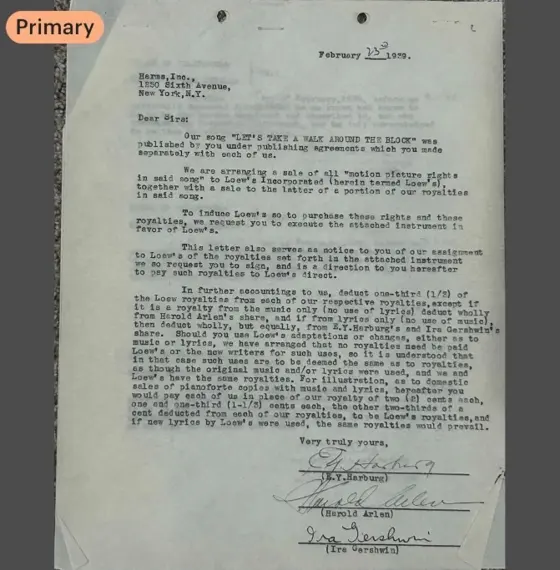
From album covers to publishing paper
- Album covers
- The fan's format. Best when the whole band signed on the original release sleeve, worst when one name is missing or the sleeve is a reissue sold as original.
- Photographs
- Easier to compare and authenticate than a glossy record jacket, where ink can skip and smear.
- Contracts, letters and rights paperwork
- Signed in the course of work. Dated, addressed and much harder to fabricate convincingly.
- Lyric sheets and setlists
- Handwritten material from the performer is a different object from a signed printout. Know which you are being offered.
- Instruments
- A large signing surface with no inherent evidence. Treat the documentation as the asset.
What is genuinely scarce
- Full band line-ups signed together, before members left or died.
- Songwriters, who signed business paper far more than they signed for fans.
- Performers whose careers ended before the modern signing circuit existed.
- Early signatures, before a name compressed into a quick mark.
Where the fakes concentrate
Bands are the problem. Road managers, fan club staff and assistants signed for musicians for decades, often well enough to fool a casual eye. The biggest names carry the biggest risk, which is why the firm's pages on The Beatles, Elvis Presley and Michael Jackson spend so long on it.
What music collectors want
Demand is strongest for acts whose music is still played across generations, and for the songwriters behind standards that are still recorded. Anniversaries, documentaries and biopics move names fast.
What sets the price
- Completeness
- Every member of the line-up, on one piece.
- The object
- Original release sleeves and period paper over reissues and reprints.
- Content
- For letters and documents, what the paper is about. A letter that names a famous song is worth more than routine correspondence.
- Provenance
- Who saw it signed, or where the paper came from.
If you are deciding whether to sell, start with the firm's piece on the three factors that set a price.
Next
Sell your music autographs
One signed album or a whole collection of music paper. Tell Piece of the Past what you have and get a straight answer on what it is worth and how best to sell it: outright, on consignment or at auction.
Request help selling